


Since the birth of transformation optics, invisibility has become an intriguing goal of scientific research. This research direction is about realizing various illusionary effects and even light-field stereoscopic display. Our previous works have gone beyond the design of invisibility cloaks to accomplish invisibility without actually cloaking the object, i.e. “cloaking” at a distance (Read more)...

When the refractive index of a material approaches zero, peculiar physical properties arise. This research direction is one of the most fundamental branches of metamaterials and may have important impact on future electromagnetic materials. Our previous design established the foundation of double-zero materials (also called epsilon-mu-near-zero materials) with both near-zero permittivity and permeability,...

Transparency and matte appearance are both vital properties of optical materials, but conflicting with each other. This research direction is about the manipulation of these optical properties using macroscopic optical metasurfaces. By exploiting extremely asymmetric diffusion of light enabled by disordered metasurfaces, we have recently developed an approach to solve this long-standing conundrum. ...

The efficient absorption of wave energy is an important subject. This research direction is about how to design broadband perfect absorbers with ultra-thin thickness, which was challenging in practice. Our previous work utilizes the principle of coherent perfect absorption to acoustic absorption (Read more) and derives the conditions of ultra-thin metamaterials for broadband perfect absorption (Read ...

Metamaterials provide an effective approach to flexibly control acoustic and elastic waves. Our work started from the early milestone works of achieving tunable shear modulus of materials and hybrid elastic solids with exceptional polarization controllability that belongs to neither solid nor liquid (Read more). Such polarization control was experimentally realized by a meta-beam with indefinite mass ...
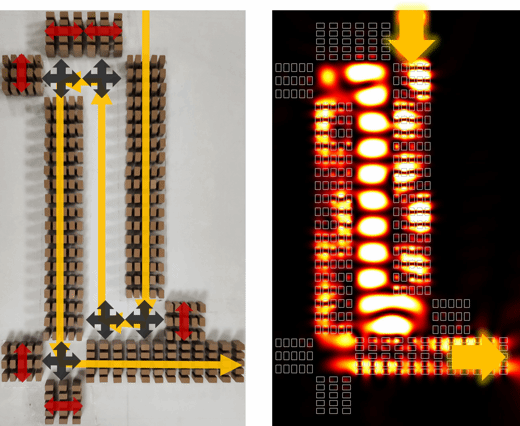
Photonic circuits are regarded as a potential route for breaking the speed limitation of electronic circuits. For the miniaturization of photonic chips, the width of the cladding separating the optical waveguides should be minimized. By designing pure dielectric structures with spatial dispersions, we recently unveiled an approach to reduce the width of cladding directly to zero (Read more), without ...
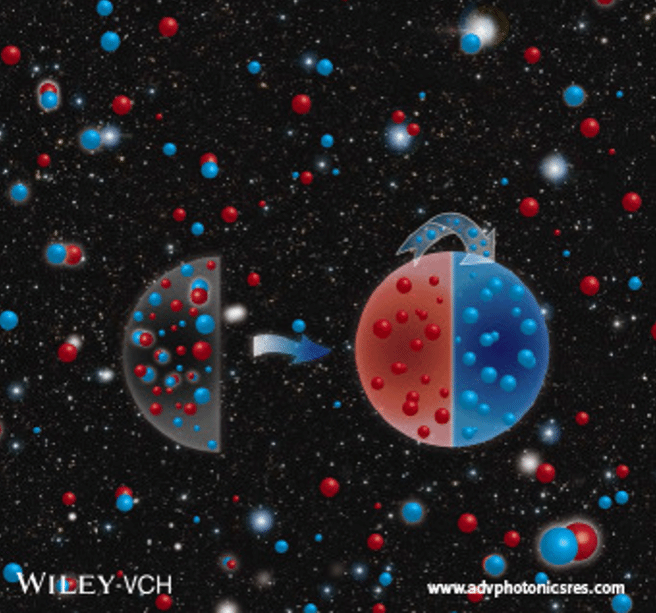
Non-Hermitian systems bare some exceptional physics like the so-called exceptional points (EPs). We previously studied the merging of EPs in a parity-time symmetric system with zero-index materials (Read more). By establishing a non-Hermitian effective medium theory, we have well explained the emergence of EP rings from the perspective of effective media (Read more). We pointed out that traditional ...
